
The Brantford Club · Since 1898
The History of The Brantford Club
How old is The Brantford Club? The Club was formed in May 1898 and officially opened on December 31, 1898, in an Italianate house at 98 George Street that is older than the City of Brantford itself. Five men founded it: a manufacturer, a banker, a publisher, a barrister, and a gentleman.
The Brantford Club opened on December 31, 1898, with only hours left in the year. The date is not club legend; it sits in the City of Brantford’s own heritage research, alongside the Club’s formation in May of that year, which the Club’s records have always described as the work of five men and five professions.
A house older than the city
The house came first. 98 George Street is an Italianate residence built around 1855, and the City of Brantford was not incorporated until 1877, which makes the building twenty-some years older than the city that grew up around it. Before the Club, it was the residence of Dr. John Y. Bown, in the City’s words a prominent physician in Brantford and Member of Parliament immediately before and after Confederation. PARLINFO still holds the result of his 1867 election for Brant North: 672 votes to 670. He died in 1890, and his widow, Margaret Macklem Bown, survived him only ten years. When the young Club went looking for a home in 1898, the house was for sale, and it changed hands for $4,500.00.
Most clubs of this age have moved, rebuilt, or burned. The Rideau Club in Ottawa lost its clubhouse to fire in 1979; Windsor’s present building dates from 1964; St. Catharines sold theirs. The Brantford Club has kept one house through two wars, the Depression, and a pandemic. Same rooms. Same staircase. Same address.

The five, now named
By the Club’s own records, five men came together in May 1898: a Manufacturer, a Banker, a Publisher, a Barrister and a Gentleman. For over a century the professions were the whole story, told without names. The names have been found.
“The Brantford Club has just been incorporated, the provisional directors being C. H. Waterous, H. R. Yates, Jeffrey Hale, A. J. Wilkes and R. H. Reville.”
The Toronto World, August 1, 1898, page 2, via Canadiana
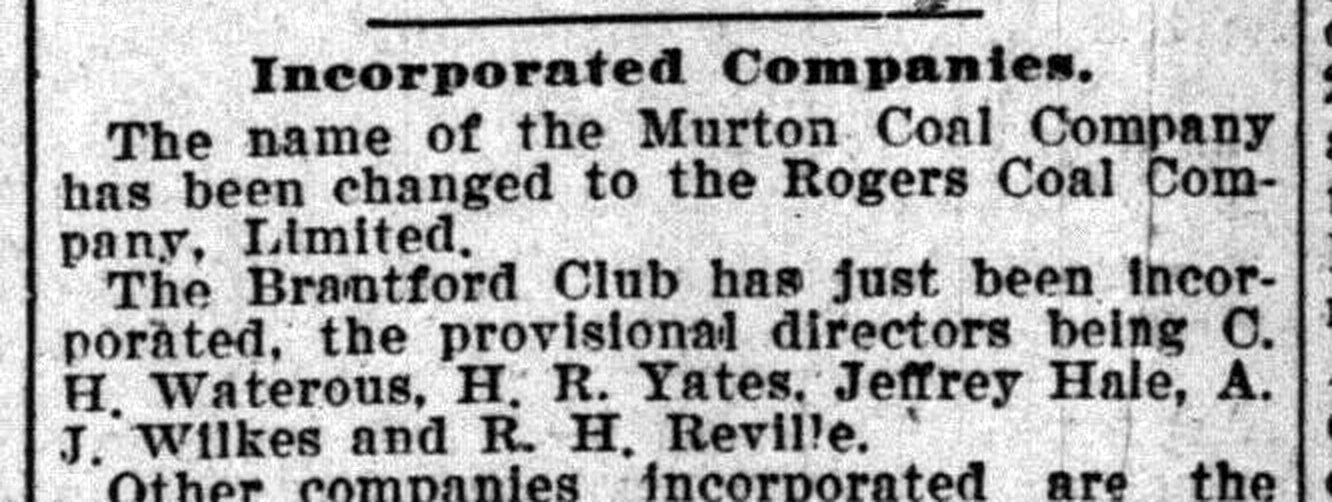
The Club’s own centennial history, privately printed for the hundredth year, supplies the day the notice never gave: incorporation by Letters Patent on July 16, 1898. The same book records that the Charter, suitably framed, hung in the dining room, and that its purpose ran five plain words: “to establish and maintain a social club.”
The founding now has its own entry in the Journal.
- C. H. Waterous Jr.
- The Manufacturer. President and General Manager of the Waterous Engine Works, the city’s first industry, founded 1844; Mayor of Brantford, 1905 to 1906.
- Jeffery Hale
- The Banker. Manager of the Canadian Bank of Commerce, Brantford branch, listed there in the Canadian Almanac for 1898 and 1899.
- R. H. Reville
- The Publisher. Ralph H. Reville of the Brantford Courier; later the founding editor of Canadian Golfer and a Canadian Golf Hall of Fame inductee.
- A. J. Wilkes, K.C.
- The Barrister. Lt.-Col. Alfred John Wilkes, called to the bar in 1869, King’s Counsel in 1890, Crown Attorney for Brant from 1899.
- H. R. Yates
- The Gentleman, as the Club’s own Charter roll styles him: Herbert Rushton Yates, Gentleman. Son of Henry Yates the railway contractor, son of Henry Yates the railway contractor, and a director of the Brantford Electric and Operating Company alongside Wilkes.
One coincidence deserves its own line. The Publisher’s brother, F. Douglas Reville, went on to write the standard 1920 history of the County of Brant, the book this page is checked against. The family that helped found the Club also wrote the shelf its story sits on.
The name in the Register
On January 3, 1901, a twenty-six-year-old Winston S. Churchill, lecturing his way across North America after the South African war, signed the Club’s Visitors’ Register: the date, the name, and under residence, “London, England.” The page survives; the Club’s centennial history reproduces it in photograph. Ralph Reville, the last of the charter men, remembered the evening for the Brantford Expositor in 1948.
“After addressing a gathering here, the young man and his manager were guests of honour at a supper party at the Club with Dr. Digby as host and approximately twenty other members as guests.”
Ralph Reville, recorded by Alice Waterous, The Brantford Expositor, 1948
The Journal gives the evening its own entry.
He was not the house’s first great name. Sir John A. Macdonald had been a guest under this roof in Dr. Bown’s day, before there was a Club; Joe Clark would lunch here decades later, the second Prime Minister to visit the premises. In 1901 alone the Register took names from Winnipeg, Rossland, Detroit, Montreal and Toronto. The door has been worth travelling to for a long time.
The city that rang first
The Club arrived in a city at full steam. Alexander Graham Bell’s own account, preserved in the Dictionary of Canadian Biography, is that the telephone was conceived in Brantford in 1874 and born in Boston in 1875, and the world’s first long-distance call ran from Brantford to Paris, Ontario, on August 10, 1876. The fuller story of why Brantford is called the Telephone City is in the Journal. By the early 1900s, Brantford stood third in Canada by value of manufactured goods exported, behind only Toronto and Montreal. Waterous had been building engines since 1844, Slingsby weaving since 1872, Cockshutt making ploughs since 1877; Verity moved its works to town in 1892, and the Harris firm became half of Massey-Harris in 1891.
Most of that world is gone. Cockshutt Plow closed in 1962, and Massey-Harris belongs to the history books. The Bell Memorial, unveiled in 1917 with Bell himself present and carved by Walter Allward, who went on to carve Vimy, still keeps its ground. And the club founded at the height of that era still sets its tables in the same rooms. This house is the era’s surviving room.
Questions about the Club’s history
When was The Brantford Club founded?
The Club was formed in May 1898 and officially opened on December 31, 1898. Both dates are recorded in the City of Brantford’s heritage research and the Club’s own records.
Who founded The Brantford Club?
Five provisional directors named in The Toronto World of August 1, 1898: C. H. Waterous Jr., Jeffery Hale, R. H. Reville, A. J. Wilkes and H. R. Yates. The Club has always remembered them by profession: a manufacturer, a banker, a publisher, a barrister, and a gentleman.
How old is the building at 98 George Street?
The house is an Italianate residence built around 1855, which makes it older than the City of Brantford, incorporated in 1877. The Club has occupied it since 1898.
Has The Brantford Club always been at 98 George Street?
Yes. The Club opened at 98 George Street on December 31, 1898 and has never left. The rooms, the staircase, and the address are the originals.
Did Winston Churchill visit The Brantford Club?
Yes. Winston Churchill signed the Club’s Visitors’ Register on January 3, 1901, during his North American lecture tour, and the Club’s centennial history reproduces the photographed Register page. Ralph Reville, one of the five founders, recalled a supper party at the Club that evening with about twenty members present.
City of Brantford heritage research; the Club’s centennial history, privately printed for the hundredth year; The Toronto World, August 1, 1898, page 2 (Canadiana); The Canadian Almanac, 1898 and 1899; F. Douglas Reville, History of the County of Brant, 1920; the Dictionary of Canadian Biography (Bell); PARLINFO (Brant North, 1867 to 1872); Morgan’s Canadian Men and Women of the Time, 1912. The 1898 newspaper notice is a period reprint of the government record. The Club’s centennial history, privately printed for the hundredth year, confirms the Letters Patent day of July 16, 1898 and preserves the photographed Visitors’ Register page; the original letters patent file at the Archives of Ontario remains worth photographing as the state record.
The first thing this room ever watched was a new year arriving.
The rooms that kept this history are working rooms still. The Club hosts corporate events and private functions at 98 George Street today; directions are on the visit page.
