
The Journal · The Brantford Club
The Rooms at 98 George Street
The Brantford Club occupies an Italianate house built around 1855 at 98 George Street, Brantford, at the corner of George and Nelson Streets across from the Court House. Inside are the dining room, the lounge, the bar, and the verandah, rooms the Club has kept and renovated since 1898.
A club is its rooms, and this house keeps a paper trail for them. The Brantford Club’s own centennial history records the additions and renovations the way it records everything else, with architects’ names and dates attached. What follows is a walk through the house at 98 George Street, taken by the record.
What is at 98 George Street in Brantford?
98 George Street is the home of The Brantford Club, a private members’ club in a house older than the City of Brantford itself, bought by the Club in 1898 for $4,500.00, the former home of Dr. John Y. Bown’s family. The rooms have carried the Club’s life since: the dining room where the framed Charter hung, the lounge with its uncovered fireplace, the bar that grew into an older room’s footprint, and the verandah that once served as a discreet second entrance. The names on some doors today, among them the Bateson Lounge and the Waterous Family Dining Room, where private dining still runs, carry the Club’s own people forward.
The dining room
Where the Club’s framed Charter of July 16, 1898 hung, its purpose clause reading “to establish and maintain a social club.” The table has been the point of the house ever since.
The lounge
The 1977 renovation uncovered an original fireplace in the lounge wall, and the centennial history records that it “has worked admirably to the satisfaction of all who gather before it on a cold winter evening.”
The bar
The 1997 renovation opened the bar into the former Inglenook Room and set a gas fireplace there. The Inglenook itself dates to the mid-1950s addition, architect Leslie Kemp.
The verandah
The Resolution of November 26, 1910 admitted lady friends to supper after eight, dining room only, by the verandah entrance. The house remembers its own manners changing.
The renovation record, 1950s to 1997
The mid-1950s brought a new kitchen and the Inglenook Room, designed by architect Leslie Kemp. The 1977 renovation, by Penrose, uncovered the original lounge fireplace. The 1997 renovation, Penrose again, opened the bar into the former Inglenook Room and installed the gas fireplace unit there. Three renovations in the record, each signed, each dated: the house changes the way the Club does everything, on the record and without hurry.
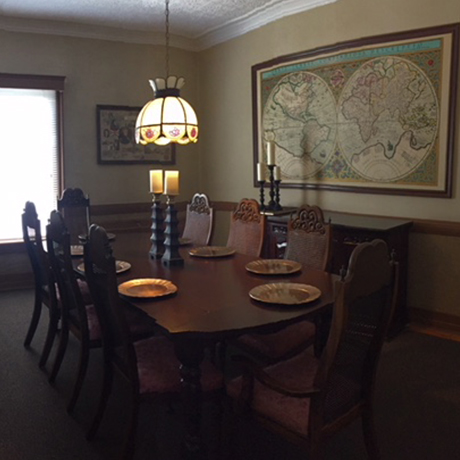
The rooms host board meetings, private dinners, and celebrations. Capacities by setup are given with a straight answer by email, and the details are on the corporate events page.
The doors have changed their names; the rooms have kept their habits.
Questions the record answers
How old is The Brantford Club’s building?
The house at 98 George Street was built around 1855, an Italianate residence that predates the City of Brantford’s 1877 incorporation. The Club has occupied it since 1898.
What is the Inglenook Room?
An addition from the mid-1950s, designed by architect Leslie Kemp alongside a new kitchen. The 1997 renovation opened the bar into its footprint, which is why the Club’s records speak of the former Inglenook Room.
Does The Brantford Club have a fireplace?
The house has them in its story at every turn: opening night in 1898 was “warmed only by the heat from the fireplaces and refreshments,” the 1977 renovation uncovered an original fireplace in the lounge, and 1997 added a gas unit by the bar.
Sources: the Club’s centennial history, privately printed for the hundredth year, for the renovations, the Charter, and the Resolutions; the City of Brantford’s heritage record for the house and its date.
The house itself has a longer story, told in the house older than the city.
The Brantford Club, 98 George Street, Brantford, Ontario N3T 2Y4 · Open in Google Maps
Rooms are for being in
A room described is a room half known. These ones are still lit, still set, and the way to see them properly is to be in one, which starts with an email.
manager@thebrantfordclub.com · 519-752-0931 · Book the Club
