
The Journal · The Brantford Club
Alexander Graham Bell in Brantford: The Homestead, the Memorial, and the First Call
Alexander Graham Bell conceived the telephone at his parents’ home on Tutela Heights in Brantford in July 1874 and built the first working instrument in Boston in 1875. The Bell Homestead National Historic Site at 94 Tutela Heights Road is the museum; the Bell Memorial stands in Bell Memorial Park at 41 West Street, downtown.
Alexander Graham Bell was the inventor of the telephone, and Brantford, Ontario, is the city where he said the idea came to him. His family took a farmhouse above the Grand River in August 1870, and Brantford has kept every place the idea touched: the house on Tutela Heights, the monument on West Street, the wire that ran to Paris, and the name the City still prints. This entry is the map to the four, written from 98 George Street, where The Brantford Club has kept its door since 1898 in a house that predates the city.
After the Homestead, George Street
A day between the Homestead and Allward’s monument on West Street can finish at a dining-room table at 98 George Street, a short walk from the bronze figures. Nobody in your Bell party has to hold a membership for that first dinner. In one email, name the day of your Bell visit and how many are travelling with you.
A visitor can stand in all four. The Bell Homestead National Historic Site, at 94 Tutela Heights Road on the heights south of the river, is Melville House, the family’s first Canadian home, kept by the City of Brantford as a museum. The Bell Memorial, granite and bronze by Walter S. Allward, stands in Bell Memorial Park at 41 West Street, a short walk from this door. The first long-distance call left the Homestead for Paris, Ontario, on August 10, 1876, so the sending end is the museum. The fourth place is the city, which Bell himself said was entitled to its name.
The Bell Homestead National Historic Site is the Bell family home at 94 Tutela Heights Road, Brantford, Ontario, run by the City of Brantford as a museum. Melville House holds the family’s original furniture and models of the first telephones, and the Henderson Home beside it holds the original telephone office of 1877.
Where was the telephone invented?
Alexander Graham Bell answered the question himself at the dedication of his monument in Brantford in 1917: “the telephone was conceived in Brantford in 1874 and born in Boston in 1875,” in the words the Dictionary of Canadian Biography records. The idea came to him in July 1874 at his parents’ house on Tutela Heights; the City’s own history gives the day as July 26 and the spot as a hollow above the river he called his dreaming place. The working instrument belongs to Boston, and so does the first sentence spoken down a wire, on March 10, 1876. The distance was proved at home. On August 10, 1876, Bell ran an eight-mile trial from his father’s house to Paris, Ontario, and listeners in Robert White’s boot and shoe store heard voices, music, and singing come over the wire, by the Dictionary’s account. The Dictionary also keeps the week before: a four-mile test on August 3 from Wallace Ellis’s general store in Mount Pleasant, over a telegraph line joined to the house with stove-pipe wire. The City’s history dates the world’s first successful long-distance call to the Paris trial.
Alexander Graham Bell in Brantford, Place by Place
Alexander Graham Bell in Brantford comes down to four places, and the table gives each the address the City of Brantford publishes for it and what a visitor finds there. The memorial, a short walk from this door, opens the Journal’s stop-by-stop walk through downtown Brantford.
| Place | Address, as the City publishes it | What it holds |
|---|---|---|
| Bell Homestead National Historic Site | 94 Tutela Heights Road, Brantford, Ontario N3T 1A1 | Melville House, the Bell family home from 1870 to 1881, with the family’s furniture and models of the first telephones; the Henderson Home beside it, with the original telephone office |
| The first long-distance call, August 10, 1876 | Sent from the Bell home at 94 Tutela Heights Road; received in Paris, Ontario, eight miles down the Grand River | The eight-mile wire from the house to a shop in Paris; the Homestead’s plaque records the trials |
| The Bell Memorial | Bell Memorial Park, 41 West Street | Walter S. Allward’s granite and bronze monument, commissioned in 1908 and dedicated on October 24, 1917; open ground, with a Historic Sites and Monuments Board plaque for Allward added in 2010 |
| The Telephone City | Brantford, Ontario; the City of Brantford at 58 Dalhousie Street | The name Bell endorsed in March 1916, still printed by the City on its own pages |
People search for a Bell museum, a Bell house, and the Bell Memorial as if the three were one address. They are two. The museum is the Bell Homestead at 94 Tutela Heights Road: a house you go inside, with rooms, a carriage house, a cafe, and admission. The Bell Memorial at 41 West Street is a monument in a park; you stand in front of it.
The Bell House on Tutela Heights
The Bell house people search for is Melville House, at 94 Tutela Heights Road, and the City of Brantford runs it as the Bell Homestead National Historic Site. The family arrived in August 1870, by the City’s history: Alexander Melville Bell, Eliza Bell, their son, and his brother’s widow, on a property the father bought within the week. Bell was twenty-three and ill with what his parents feared was tuberculosis; eight months on the farm put him right, and he went to Boston to teach the deaf, coming home for the summers. The Bells sold the farm in April 1881, and after six more owners the house was given to the Brantford parks department in 1909, to be opened as parkland and a museum. Parks Canada’s Directory of Federal Heritage Designations lists it as a National Historic Site of Canada; the City’s history records Queen Elizabeth II declaring it one on June 28, 1997. The Journal’s own entry on the house is the Bell Homestead; the City of Brantford’s Bell Homestead page carries hours and admission.
The Bell Memorial on West Street
The Bell Memorial is the granite and bronze monument in Bell Memorial Park at 41 West Street, downtown. The City of Brantford’s public art record gives the commission to the Bell Memorial Association in 1908, the sculptor as Walter S. Allward, and the dedication as October 24, 1917, by the Duke of Devonshire, the Governor General, with Bell in attendance. Allward set two bronze figures on the granite, sending and receiving, with the line of a telephone between them and the curve of the earth binding the whole, and a stone fountain with bullfrog gargoyles at the back; the Canadian Register of Historic Places carries that description from the City’s by-law of 2005, which designated the monument under Part IV of the Ontario Heritage Act. Allward went on from West Street to the Canadian National Vimy Memorial in France, and the City rededicated the monument on October 24, 2017. The Journal’s entry on the dedication of 1917 has the competition, the rain, and the luncheon.
The Telephone City, and the Room That Made It Wait
Brantford became the Telephone City on the inventor’s word. In a letter to the Daily Expositor in March 1916 Bell wrote that “Brantford is justified in calling herself ‘The Telephone City,’” as the Dictionary of Canadian Biography records. The Journal’s entry on why Brantford is called the Telephone City sets out the whole record. In the years the name was settling, The Brantford Club opened its door at 98 George Street on December 31, 1898, in an Italianate house raised about 1855, older than the City’s own incorporation in 1877. The Club’s Minutes of May 28, 1911 then recorded the rule that a member was never to be interrupted by the telephone at his meal; the Journal’s entry on the telephone rule of 1911 prints the motion. The house on George Street makes no claim on Bell himself. Its claim is on the era, which it watched from across the street from the Court House.
“Guests who have spent the day at the Homestead often ask me whether Bell ever came through our door. I tell them the house makes no claim on him, then tell them about the 1911 rule on telephones at dinner. Most of them laugh, and a few put their phones face down on the tablecloth.”
Sabrina Van Leeuwen, Club Manager
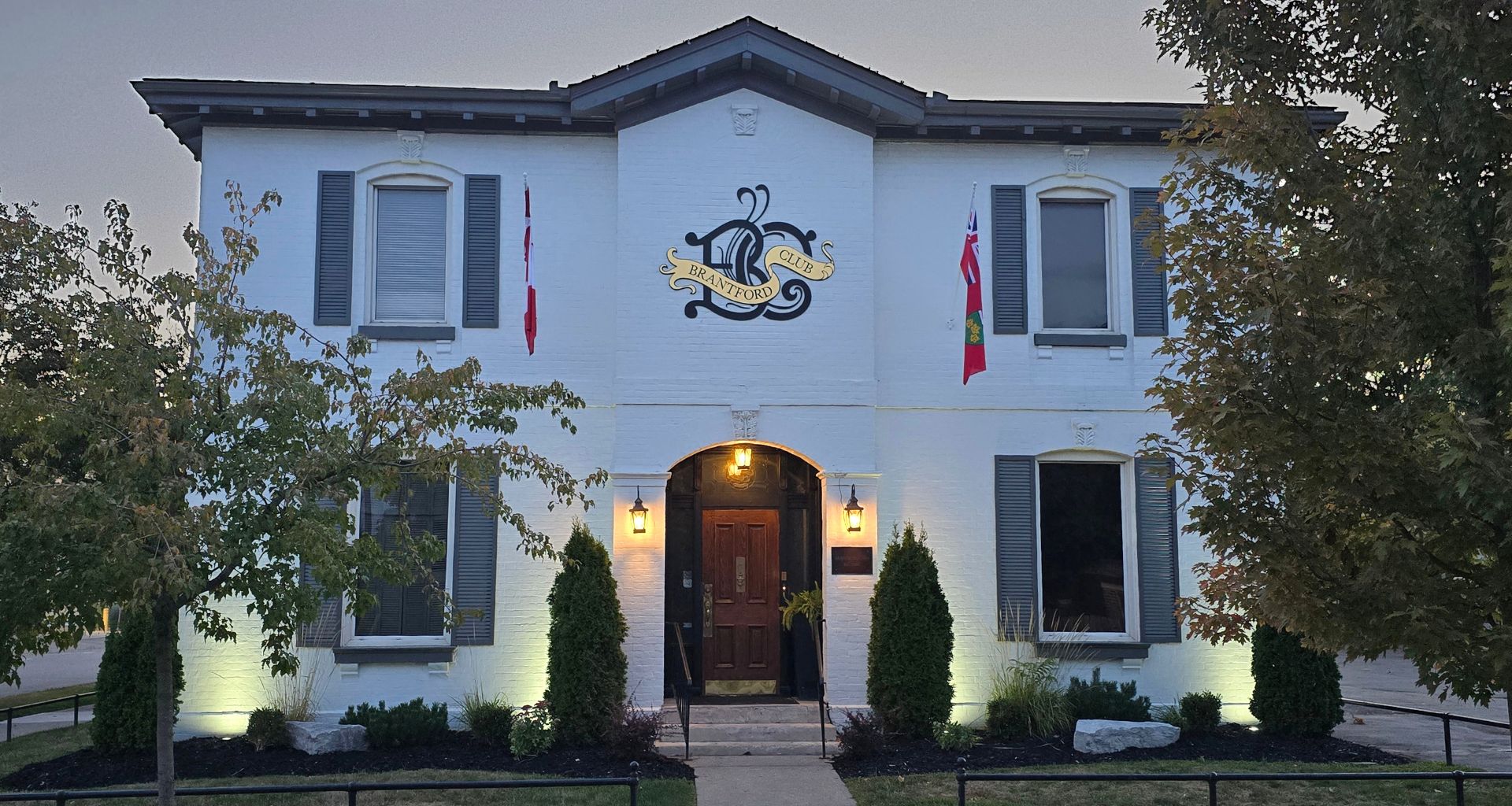
The house on George Street was already standing when the idea came down from Tutela Heights; its door opened as the Club’s while the city was still learning its new name.
Asked at either door
Is there an Alexander Graham Bell museum in Brantford?
Yes. The Bell Homestead National Historic Site at 94 Tutela Heights Road is the museum, run by the City of Brantford. Melville House holds the Bell family’s original furniture and models of the first telephones, and the Henderson Home beside it holds the original telephone office. Hours and admission are on the City’s Bell Homestead page, and the site answers at 519-756-6220.
Where is the Bell Memorial?
The Bell Memorial stands in Bell Memorial Park at 41 West Street in downtown Brantford. It is a granite and bronze monument by Walter S. Allward, dedicated on October 24, 1917, on open ground with nothing to enter.
Was the telephone invented in Brantford or Boston?
Both, by the inventor’s own account. The idea came to Bell at his parents’ home on Tutela Heights in July 1874, and the working instrument followed in Boston in 1875. The first long-distance call ran from the Brantford house to Paris, Ontario, on August 10, 1876.
What is the Bell House in Brantford?
The Bell House people search for is Melville House, the Bell family’s first Canadian home from 1870 to 1881, at 94 Tutela Heights Road above the Grand River. It has been public property since 1909 and is kept today as the Bell Homestead National Historic Site.
Can you visit where the first long-distance call was made?
Yes, at the sending end. The call of August 10, 1876 left the Bell home, now the Homestead museum at 94 Tutela Heights Road, and was received eight miles away in Paris, Ontario, in Robert White’s boot and shoe store.
Sources: the Dictionary of Canadian Biography’s entry on Alexander Graham Bell, for his words of 1916 and 1917 and the trials of August 1876; the City of Brantford’s Bell Homestead page and its history of the Homestead, for the address, the July 26 date, and the 1909 gift; Parks Canada’s Directory of Federal Heritage Designations, for the plaque; the City’s public art record and the Canadian Register of Historic Places, for the monument; and the Club’s centennial history, for the Minutes of May 28, 1911. The wider list of places is in the Journal’s register of historic things to do in Brantford. The other pairings are shelved together in the Journal’s register of comparisons.
The Brantford Club, 98 George Street, Brantford, Ontario N3T 2Y4 · Open in Google Maps
Kept downtown, since 1898
The City keeps Bell’s house and his monument, and this house keeps its Minutes. Both records are open to a reader; the rest of ours, from the Charter to the Register, is on the history page.
Our history · The Journal · manager@thebrantfordclub.com · 519-752-0931
