
The Journal · The Brantford Club
The Brantford Club Founders, Traced Through the County History
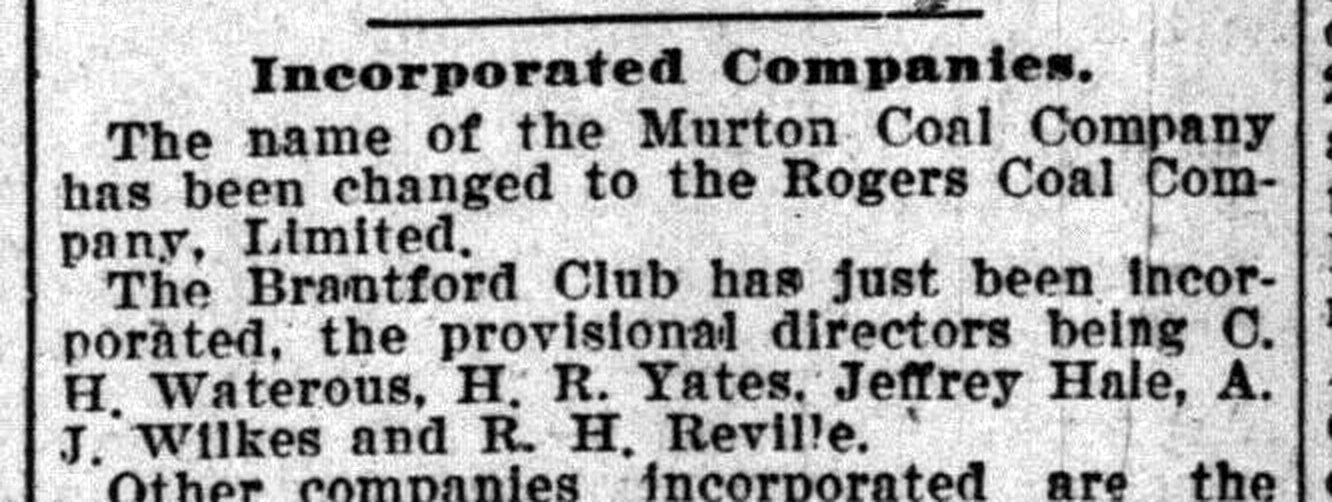
The Brantford Club’s Charter roll of 1898 reads: Charles Waterous, Manufacturer; Jeffery Hale, Banker; Ralph Henry Reville, Publisher; Alfred John Wilkes, Barrister; Herbert Rushton Yates, Gentleman. F. Douglas Reville’s 1920 History of the County of Brant lets us follow four of the five through the city’s own record.
A membership roll is a list of names; a county history is where the names go to be explained. In 1920, F. Douglas Reville published his two-volume History of the County of Brant, and the men who signed the Club’s Charter in 1898 walk through its pages on their other business: committees, courtrooms, council seats, factory floors. This entry takes the five Charter names, as the Club’s centennial history prints them, and follows each one through the county’s book.
Followed to the front door
Four of the five can be followed through Reville’s two volumes, and the club they chartered can be followed to its door at the corner of George and Nelson. A first dinner under that roof wants no membership, from you or from your guests. Write once with an evening and how many to set places for, and the manager writes back to settle it.
Who founded The Brantford Club in 1898?
The five charter men of The Brantford Club, per the Charter roll the Club’s centennial history reproduces, were Charles Waterous, Manufacturer; Jeffery Hale, Banker; Ralph Henry Reville, Publisher; Alfred John Wilkes, Barrister; and Herbert Rushton Yates, Gentleman. The Toronto World printed the incorporation notice naming the five on August 1, 1898. The Club they formed opened at 98 George Street on December 31, 1898, and has held the address since.
The Manufacturer
Reville’s history tells the firm’s story before the man’s: machinery-making that began in the 1840s as Ganson & Waterous, carried forward as the Waterous Engine Works Co., which the county history says “has a world-wide reputation.” That is the enterprise standing behind the first name on the Charter roll. Charles Waterous, the Manufacturer of 1898, went on to serve as Mayor of Brantford in 1905 and 1906, which means the Club’s Charter carries a future mayor in its first line.
The Publisher, Twice Over
Ralph Henry Reville signed the Charter as Publisher of the Brantford Courier, which the county history calls the oldest of the city’s papers, a masthead running back to the 1830s. The twist is on the book’s own spine: the county history the Club leans on for its city’s story was written by F. Douglas Reville, the Publisher’s brother. One Reville kept the city’s daily record; the other bound its whole century. The Journal’s account of the Bell Memorial’s day in October 1917 is taken from the county history. The Club’s Charter holds the family’s newspaper line.
The Barrister, Public Property
Alfred John Wilkes appears in the county history the way a working barrister should: on the Bench and Bar roll as A. J. Wilkes, K.C., and as President of the Brantford Opera House Company when the city rebuilt its stage. Earliest of all, the book places him on the executive committee struck on April 14, 1876 to raise the Brant Memorial, twenty-two years before he signed the Club’s Charter, and on that same 1876 committee sits G. H. Wilkes, Deputy Reeve, the man who would become the Club’s first Honorary Secretary. Two future officers of a club that did not yet exist, already doing the city’s work at one table.
The Gentleman, and an Honest Blank
Herbert Rushton Yates signed as Gentleman, the only man of the five with no trade on the line. The Yates name itself runs deep in the county history; a Henry Yates sits in the Brantford council lists from 1859 onward and on the 1876 memorial committee. Whether the Gentleman of 1898 drew his standing from that same line, Reville does not say, and the Club’s records do not say either, so this entry will not say it for them. A club that keeps honest minutes keeps honest blanks.
“Herbert Yates is the name guests stop on. Everyone else on the roll has a trade, and people want to know what a Gentleman did with his days. I tell them the record does not say, and most of them seem to like the house better for not making something up.”
Sabrina Van Leeuwen, Club Manager
The Banker the County History Missed
Jeffery Hale, Banker, is the one Charter name the county history never mentions. The Hales in Reville’s pages are an innkeeper and a visiting writer, not the Banker of 1898. A bank manager’s posting was a moveable thing, and the county’s book had a county’s worth of names to hold. Hale stands instead on the almanac record of his day, which lists his bank and his standing in the city. Four founders in the book, one in the ledgers: between them, the record holds all five.
Four of the five are in the county’s book; the fifth kept his name in a ledger instead.
Questions readers ask about the founders
Who wrote the History of the County of Brant?
F. Douglas Reville, published in Brantford in 1920 in two volumes. He was the brother of Ralph Henry Reville, the Brantford Courier publisher who signed the Club Charter in 1898.
Was a founder of The Brantford Club ever mayor?
Charles Waterous, the Manufacturer on the 1898 Charter roll, served as Mayor of Brantford in 1905 and 1906.
What did the founders do before the Club existed?
The county history shows them at the work of the city: A. J. Wilkes and G. H. Wilkes sat on the 1876 committee that raised the Brant Memorial, and the Waterous firm had been building machinery in Brantford since the 1840s.
Why is Jeffery Hale missing from the county history?
The 1920 history simply never mentions him; bank managers moved with their postings. His record stands in the almanacs of the day, which list him as a Brantford banker.
Related: the founders, found · the city the five men worked in
The Brantford Club, 98 George Street, Brantford, Ontario N3T 2Y4 · Open in Google Maps
The roll the five men started
The county history gave the founders a few hundred pages between them; the Register gave them one line each. There is room on the page.
manager@thebrantfordclub.com · 519-752-0931 · Membership at the Club
